
A Generation Posting Through It
Some thoughts on the inescapability of content

By now, you’ve probably seen the video of Charlie Kirk’s assassination. You may not have sought it out. You may have even thrown restrictions on sites like X to try and block the truly grotesque video from autoplaying on your feed while scrolling for updates. You may have hoped that some of the strongest machine learning restriction tools powering Instagram, TikTok, and YouTube’s feeds would stop those videos from seeping through into your wind down after work.
And yet, if you opened any of the apps that we rely on for information, for entertainment, for social connection, you were almost guaranteed to see the video in some capacity. Because the most extreme videos breed responses. They breed extreme reactions. In more clinical corporate speak, they breed engagement. When engagement is the only metric that machine learning algorithms favor — by definition, curation tools that can not be programmed with empathetic or moralistic judgement — then it’s the worst type of content that is going to get played again and again. Four studies produced in the U.S. and the U.K. over the last year show that people on social media are nearly twice as likely to share links to negative stories than positive ones. This means that people who are either seeking out attention — or even connection (which may be disguised as attention) are more likely to share these types of videos and posts because they subconsciously associate that sharing with engagement.
This type of behavior doesn’t begin and stop with the most gruesome imagery. It wasn’t just videos of Kirk’s death that circulated on different feeds. I saw students filming themselves in the immediate aftermath. One video I came across showed a TikTok creator filming people running from the shooting site, taking about 40 seconds to show the horrifying chaos surrounding students in attendance, but ending on a “make sure you subscribe” message. Nothing about the video’s existence is startling, which is in itself an alarming realization. We expect to see these kinds of POVs the second after a major traumatic incident takes place. On the one hand, filming a news event and posting it is, on some level, journalistic. On the other hand, however, it’s the exact type of situation that incentivizes people who participate in an attention-laden, video-first ecosystem to act in ways they may not otherwise.
It got me thinking, “Why do we continue to post these things when we know all it does is make us more miserable?” Well, as NYU’s Center for Conflict and Cooperation published in May “because our brains naturally pay more attention to threats or negative content, the algorithms that decide what we see end up promoting more of that kind of content:outrage, division, and fear.
“It also incentivizes social media users and content creators to ‘hack’ our brain’s attention system by producing negative and attention grabbing content,” NYU’s Center added in the newsletter.
In a related piece, I loved how Elizabeth Lopatto talked about our current age of reducing everyone to content. Her piece was published before Kirk’s shooting, but apt in its observations given some of the immediate reaction. Lopatto notes, “Social media has long been a game of roulette with fame at one end and public disgrace at the other…Now all it takes to become the internet’s main character is to appear in public, where people film each other to perform the dual task of policing behavior and creating potential viral content.”
It’s that phrase — where people film each other to perform the dual tasks of policing each other and creating potential viral content — that captured some of the incentive for some people to show up to previous Kirk rallies. If I were to push on that psychology a little further, the incentivization behind some of these decisions is belonging, and belonging in 2025 is a combination of short lived physical events that create a long tail social currency. Going to see someone as divisive, but undeniably charismatic as Charlie Kirk is ultimately a short-lived event. But being able to record the right soundbite with the right person at the podium may lead to far longer lasting social capital. Combine this incentive with a college campus, and what you have is constant filming.
As Lopatto (who again did not write about Kirk but I think gets to the heart of people being reduced to content) notes in her piece, one man named Matthew who got doxxed by facial recognition software after giving a 30 second interview to an influencer at a Taylor Swift event, “got more than 2,000 follow requests on Instagram, someone emailed him at his work account, and he received ‘dozens of DMs asking me things like ‘what is my OnlyFans.’” Everyone is content, and every event that’s participated in is an attempt to gain social capital.
No one understood this better than Charlie Kirk.
Part of what made Kirk work so well in today’s political media is his understanding of four important strategies:
Focus on young audiences who are constantly filming
Dive into topics young people actually care about
Go viral by leaning into extreme soundbites
Reward college student participation through potential virality
In a diagram form, it looks a little like this:
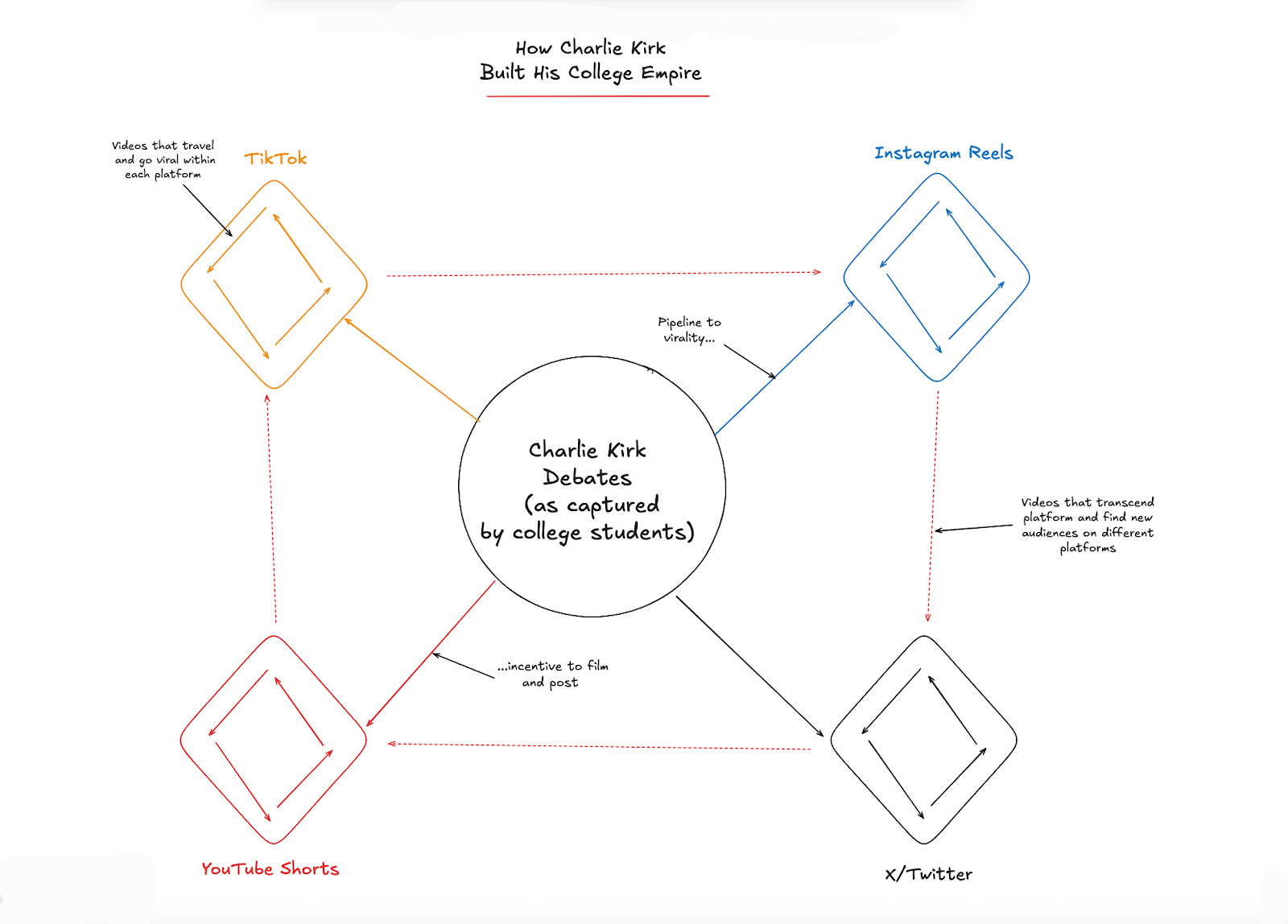
No one on the right, or the left, better understood the rules of incentivization in a hyper online and increasingly lonely world better than Kirk. He worked the algorithm, and the people who contributed to that algorithm through posting and consumption, better than anyone. People loathed his opinions, or they celebrated them, but they were constantly shared online. It’s no surprise that people who attended any of his events — not just the most recent — leaned into the risk and reward situation he created of social glory or social ridicule. Frankly, no one encapsulated the modern internet more.
But the problem with everything becoming an excuse for content, with every person reduced to the potential they give someone else for 15 minutes of fame, is that judgment on what to share, when to share it, and where to share it disappears rather quickly. Whether it’s horrific videos of Kirk’s violent and tragic death, or videos from the scene, asking viewers who are being served these videos regardless of whether they wanted them or not, to subscribe to a channel, it becomes a question of what this moment can do for me rather than a moment to reflect on what the hell is happening to us.
Part of that answer is in the loneliness of this generation and of our world. When everything was happening yesterday, when emotions were running high and many of us were experiencing anxiety-induced nausea, one of my closest friends asked if anyone wanted to get a drink after work. Without saying it, she was asking if we wanted to take our eyes away from our screens, away from the theories and the videos, and sit face-to-face with one another for a couple of hours to decompress. Instead, many of us in that group chat went home and watched more videos, opened more apps. I wouldn’t say that anyone in my close friend group is particularly lonely. We are fortunate to live a very active social life. But we were also texting non-stop, sharing videos, and watching what other friends were saying in their Instagram close friend stories. We were engaging without meeting.
“I think a bunch of factors—including comfortable homes, ample entertainment, an on-demand delivery economy, and the dopamine-exhausting effect of non-stop phone use—are overriding, or fundamentally altering, people's desire to be physically around other people,” author Derek Thompson tweeted earlier this year. “The crisis is aloneness. And it's being partly caused by, in a weird way, our inability to connect with the healthy feeling of loneliness.”
Thompson’s argument is driven by data. He notes that “the evidence that loneliness is rising for all ages that use social media is surprisingly weak.” He added that if “we understand loneliness narrowly as something like ‘an experienced gap between our felt and desired social connection,’ then loneliness is kind of good, in small doses. Loneliness is social motivation. And we'd expect that a shock of social isolation—like, say, COVID—would lead to strong efforts among people to socialize more.
“But the data shows something closer to the opposite. Face-to-face socializing continued to decline between 2021 and 2024 and alone time increased, for almost all groups.”
For some reason, I kept thinking about this with Kirk and the people who showed up to his rally with a cellphone in hand, already recording. The promise of attending a Kirk rally and potentially interacting with people someone agrees or disagrees with is almost a guaranteed second to the potential of having something to post a couple of minutes later. Human connection is secondary to social reward. Humanity is second to content. That’s what stuck with me with each video that I came across. His violent death became another posting opportunity. For some, it was an opportunity to connect during a period of increased isolation — to try and process this moment with other people in their circles. But people who use social media subconsciously know that a negative, traumatic event that encourages people to share their thoughts condemning it, or using it as a peg to post about other related topics like gun control laws, will receive more engagement than a selfie or a personal accomplishment. Attention and connection get inflated on the internet.
Everything about the very phones we use to capture footage — just a few days ago, Apple was touting its incredible new TikTok ready camera features and its 8x zoom function — to the expectation of these moments living on in the feeds we peruse every day is designed to capture attention. I worry about what that means in a climate where violence, not just political or international, but violence as a whole, continues to escalate.
“In a culture accustomed to living amongst so many horrors, when only the most visceral of them evoke empathy, how much can we preserve for those that don’t get caught on camera?” Rebecca Jennings of Vulture wrote yesterday.
I really don’t know, but I’m worried that in our continued moment of escalation — violence, attention, loneliness — we’ll be forced to see more and more of these videos cross our feeds. We can’t exactly opt out, either. Our lives, our news, our entertainment are increasingly on these platforms. To connect with the world today means opening ourselves to more and more of these videos.
Connection is created in the friction between people. Remove that friction and this is what happens. ⚡️